
Unity and Fraternity: The Jikirs and Jaris of Ajan Fakir
Devotional songs written in Assamese verse, which propagate love for God and spread the messages of sermons.
Long before Muslims rulers arrived in the Indian subcontinent, starting in the 7th century, contact with Islam was established through seafarers, traders and the occasional sufi. This contact wasn’t restricted to a specific region and they seamlessly adapted to the local culture of different regions.
Hazrat Shah Milan, also known as Ajan Fakir, came to Assam from Baghdad in the later part of the 17th century. Staying at a shrine of a preceding Islamic saint, he got acquainted with Assamese as a language and as culture. While he had come with the purpose of proselytizing Islam, he devoted his lifetime to the upliftment of the downtrodden, attracting a wide following across religions.
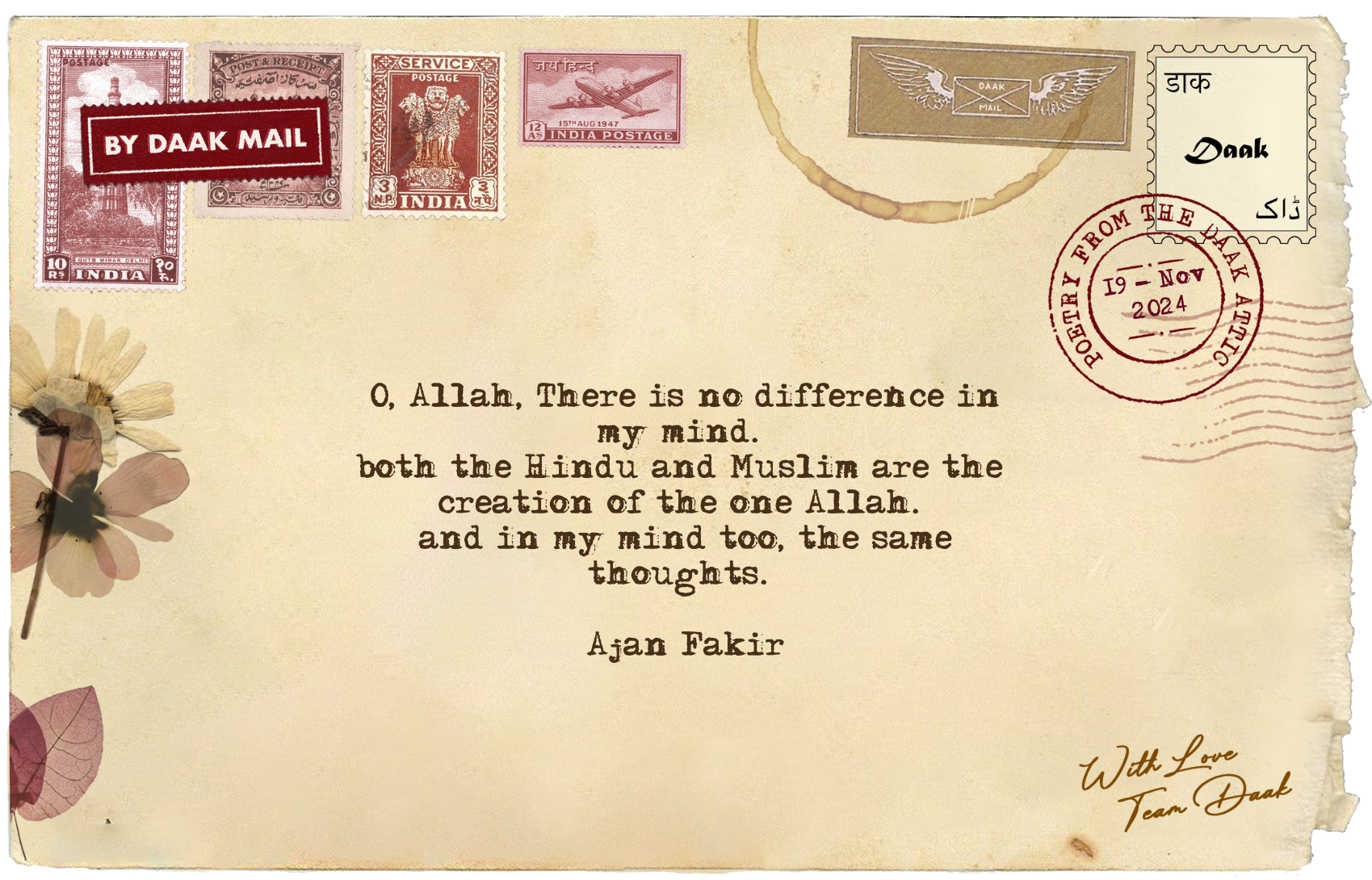
Understanding the beat of the culture, he devised an alternate method of liturgy — he wrote in Assamese verse to preach Islam. These devotional songs, termed as jikirs, propagate love for God and spread the messages of sermons. Their style of composition and presentation imitate the devotional songs of the region. His jikirs and jaris were clearly inspired by Assamese cultural heritage and older, more familiar devotional songs of the region. The culture of Muslims in Assam has since been a mixed one. The message of unity and fraternity which was the message of Ajan Fakir, is depicted in the following jikir he composed,
mor manat bhin par nai, oi Allah
mar manat bhin par nai
hindu ki mussalman ekei allar forman
mar manat eketi bhab.
//
o, Allah, There is no difference in my mind.
both the Hindu and Muslim are the
creation of the one Allah.
and in my mind too, the same thoughts.
While the jikirs were elegies and jaris contained stories of Islam, both were based on Assamese tune and idiom, occasionally interspersed with snippets from the Quran. As a result, many Arabic words were introduced into the Assamese language and remain in use today. In this jari below, we can notice anecdotes from the battleground of Karbala.
khanjan pakhir buku kala are kala bhomora
tar chaya adhik kala mar kalijar angera
uthare pubali haiwa maor kalija hauk thanda
amra dui bhai ranne zai khusi mane biday deo
ranne pariye geiche mariye, pariya ache khat-palong
nidhuwa pathare zaya sonar jaduk deo mati.
ke ke nibe kodal, pasun, ke ke nibe sangarl,
nidhuwa pathare zaya sonar jaduk deo mati
uriye uriye zaya re kabitar asmaner maje,
imamer dukh dekhiye name kabitar jamine.
//
The chest of Khanjan bird is black, Bhomora is blacker than that
The heart of mother Fatima has become blacker than all these!
O East wind, blow and cool down the burning heart of the mother
We are two brothers, going to battlefield. Bid us farewell happily!
Both the brothers have been killed in the war and the beds are lying vacant,
Bury the dear one in the graveyard!
Who shall take the hoe and instruments, who else the straw?
Go and get the golden wand, down the lane.
The pigeons fly in sky and come down to earth seeing the tragedy of the Imams.
(Translations by Sanjoy Paul)