
Time, Love, Desire and Other Musings: N. M. Rashid’s, Hassan Koozagar
One of the greatest free verse poems in the Urdu language, which is a glorious testament to love and creativity.
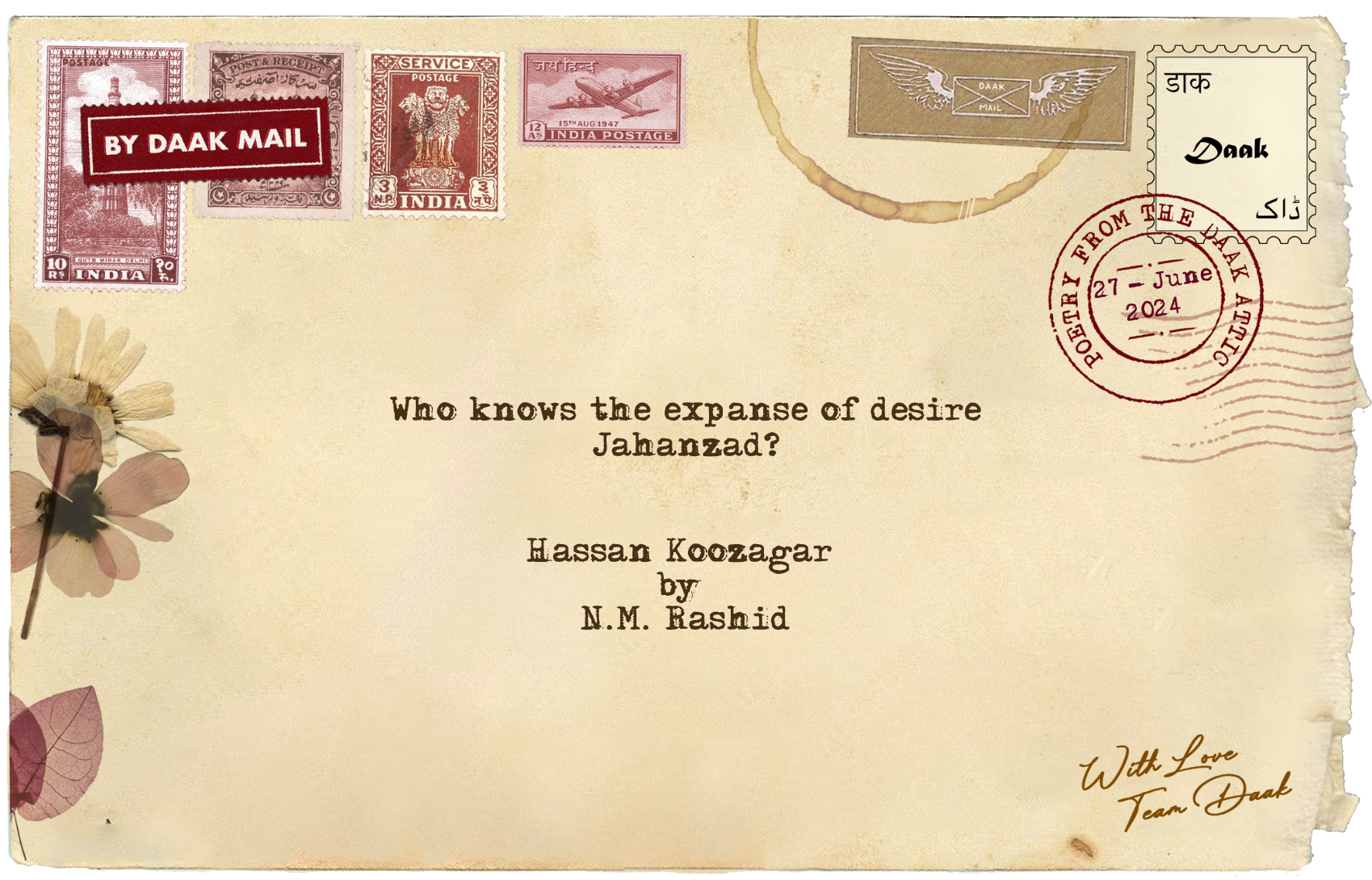
N. M. Rashid wrote what is arguably the greatest free verse poem in the Urdu language and a glorious testament to love and creativity. His poem, Hassan Koozagar (Hassan the Potter) tells the story of the unrequited love of a master craftsman. Moving from art, artist, and a creator’s relationship with work, to love and longing, this four part monologue moves across time, geographies and themes of human life with effortless ease and bejewelled language. Through the poem he addresses Jahanzad, daughter of the world, who he claims to have loved through nine years of separation.
There are many things one can pick from the poem yet we pick two: an eloquent and eerie description of passing time, and his ponderings on love.
vaqt kya cheez hai tu janti hai?
vaqt ik aisa patinga hai
jo divaaron pe aainon pe
paimaanon pe shishon pe
mire jaam o subu mere taghaaron pe
sada rengta hai
rengte vaqt ke manind kabhi
laut ke aaega hasan koozagar-e-sokhta-jan bhi shayad
//
Time
Is the moth crawling,
On the walls, mirrors, cups and glasses
On my jars, pitchers and pans
Like crawling time perhaps,
Hassan the potter will return, his soul burning.
And the despondence in his language when he talks of why we love:
mere iss jhonpade mein kuch bhi nahin
khel ik saada mohabbat ka
shab o roz ke is badhte hue khokhle-pan mein jo kabhi khelte hain
kabhi ro lete hain mil kar kabhi ga lete hain
aur mil kar kabhi hans lete hain
dil ke jeene ke bahane ke siva aur nahin
harf sarhad hain jahan-zad maani sarhad
ishq sarhad hai javani sarhad
dil ke jeene ke bahane ke siva aur nahin
dard-e-mahrumi ki
tanhai ki sarhad bhi kahin hai ki nahin
//
In this, my cottage there is nothing
A game of simple love
We play
In the growing hollowness of night and day,
Crying, singing, laughing,
Together,
Just an excuse to keep the heart alive, no more
Love, youth, tears and smiles,
All have limits
(Have then the pain of loss
and isolation, no limit, no end?)
And finally, that resounding, universal question:
tamanna ki vusat ki kis ko khabar hai Jahanzad
//
Who knows the expanse of desire Jahanzad?
Read the full poem and translation, read it in the Roman script, or listen to quite possibly its best rendition.