
The Artist of All Nations: Abdur Rahman Chughtai’s Syncretic Paintings
A painter who drew from the many strands of tradition he saw around him, depicting “gods and courtesans with equal affection.”
Abdur Rahman Chughtai (1894 – 1975) was a Pakistani painter noted for his unique work that was influenced by a plethora of styles and themes. His work drew from traditional miniature painting, Art Nouveau, and Islamic traditions of calligraphy, amongst others. As a pupil of Abanindranath Tagore, the influence of the Bengal School is also visible in his art.
As with his style, his subjects also drew from the many strands of tradition he saw around him — he painted Hindu deities, as well as famous personalities from Islamic stories and traditions. Chughtai brought to life the legends, myths and folklore of Punjab, Persia and the Mughal world. It is often said that he depicted “gods and courtesans with equal affection.”
A prolific artist, he created thousands of watercolours, drawings, and prints but it is his dream-like portraits that are his most well-known creations.

Untitled (Hasrat Stare) by Abdur Rahman Chughtai, ca 1960, Source: Bonhams

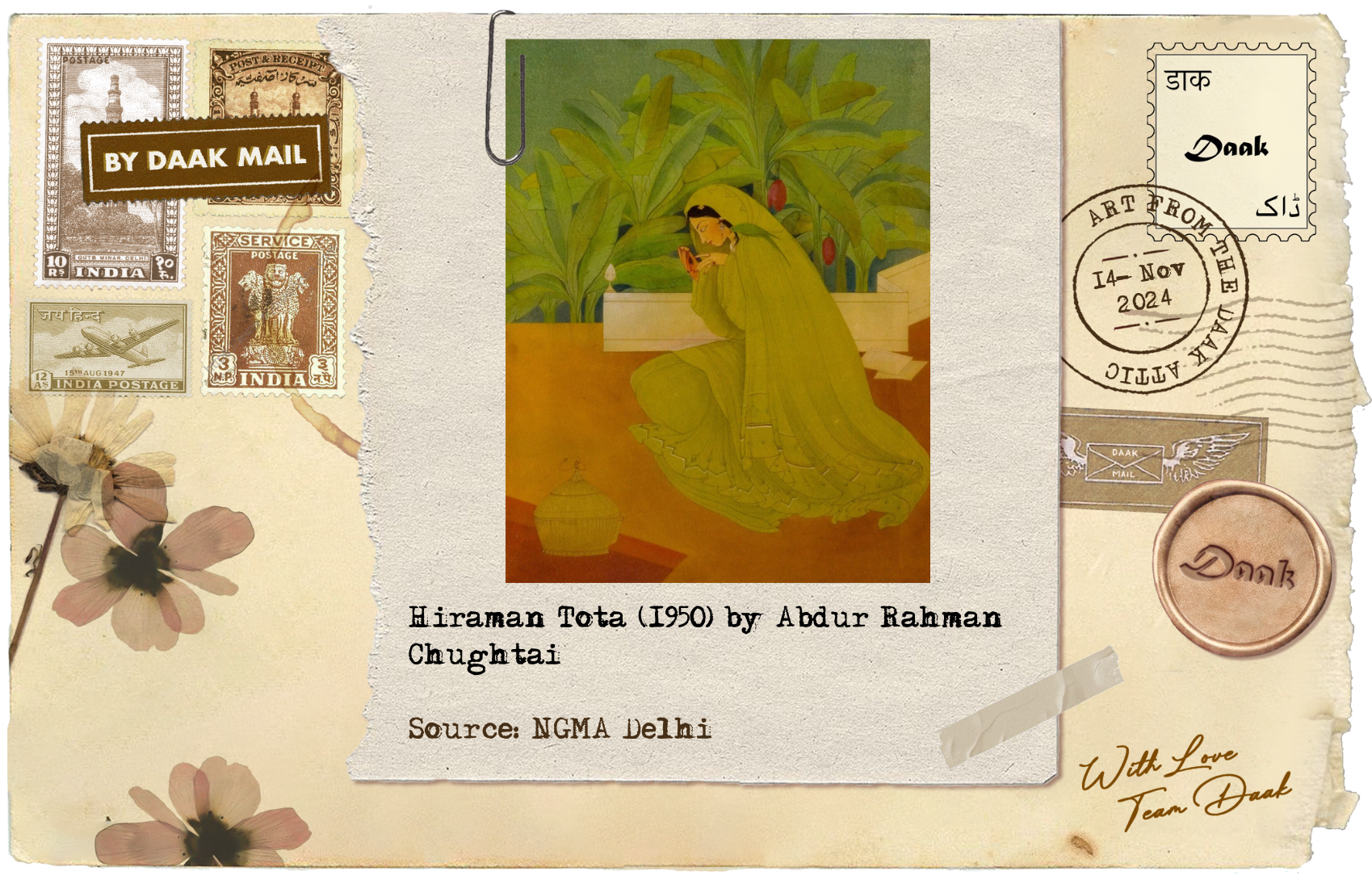
Hiraman Tota by Abdur Rahman Chughtai, Source: Pinterest
The first painting above is from a series exploring adolescence and closely observes this young woman who seems unsteady and unsure in the exploration of her youth. The second, considered Chughtai’s most famous work, is a depiction of the Rajput Queen, Rani Padmavati, with her talking parrot Hiraman.

Radha Krishna by Abdur Rahman Chughtai, Source: Rare Book Society of India

Laila with Deer by Abdur Rahman Chughtai, Source: Christie’s
Radha and Krishna, from Hindu mythology, also form a part of his work as do allegorical references and illustrations of Persian folklore. Metaphors of moths around a flame, and the legend of Laila Majnu also find place in his work.
His wide ranging themes and syncretism in art remind us of the words of S. Kashmira Singh, who said “Posterity will remember him as the greatest exponent of the spirit of Indian art in [the] Modern Age.” Looking at his work retrospectively, one can see the truth in her pronouncement.