
Longing and Tragedy in a Kashmiri Queen’s Verses: Habba Khatoon’s Poetry
Poetry laden with references to flowers, spring and Kashmir, and weighed down by the love's longing.
Mughal-e-Azam tells us a tale contrary to the otherwise glorious accounts of the Mughal Emperor Akbar. It tells a heart-wrenching story of a blooming romance between a courtesan and the Prince, and how it was put to an end at the orders of the Emperor. Although the veracity of this tale is doubtful, like all legends, it survives and is retold. However, this isn’t the only romance that Akbar prematurely ended. There is yet another epic, often told and retold in Kashmiri folklore that doesn’t find mention in popular narratives. This romance too, was throttled by Emperor Akbar for the conquest of the crown jewel of the Mughal Empire, Kashmir.
Habba Khatoon was a Kashmiri poetess in the 16th century, who Yusuf Shah Chak, King of Kashmir, spotted one day in the fields. He fell in love with the beauty of her voice and richness of her rhyme. He is said to have relieved her of her earlier marriage and taken her away to his court where she enchanted him with her poetry while reigning as queen for six years. At the end of these six years, Yusuf Shah was summoned to Delhi by Emperor Akbar. Akbar had failed to conquer Kashmir militarily and had resorted to deception. Upon reaching the Mughal court, Yusuf Shah was flung into prison, never to see the light of day again, never to see Habba again. For the rest of her years, Habba pined away in a home next to the Jhelum where she finally lay to rest.
ratshi ratshi retakol chhum soraanai, bara maa gatshan acchi posh
kuni hita bulbulo yita aki aanai, chhaav myaany daanai posh
//
With summer steadily on the wane, These champa flowers soon may wither
O bulbul, be here before they fade! Enjoy my pomegranate blossoms!
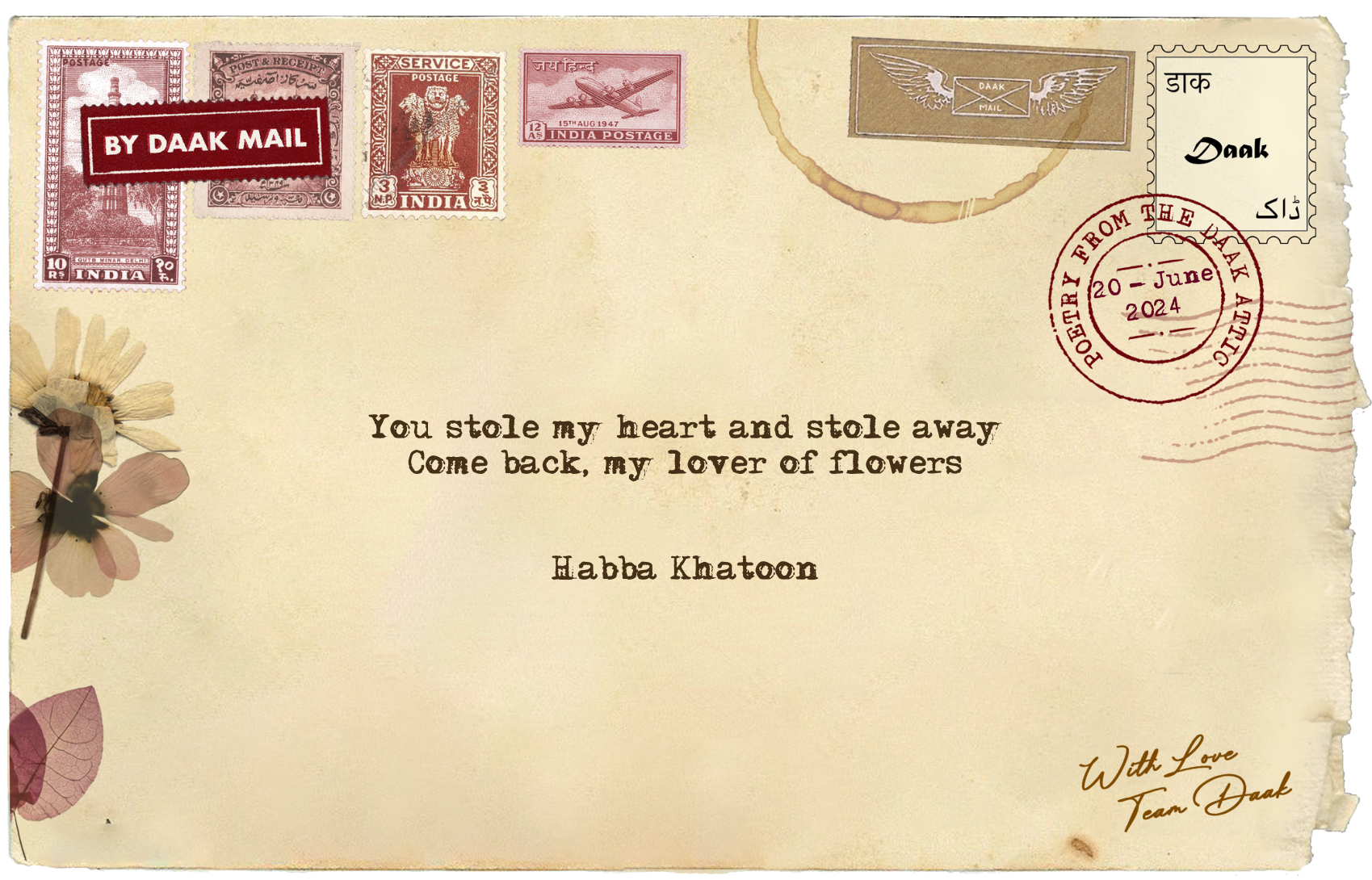
There exists little documentation of the story of Habba Khatoon and Yusuf Shah Chak, yet it has been passed down for generations, slowly but inevitably making its way into historical records and books of lore. Her poetry is rich with metaphors of nature, laden with references to flowers, spring and Kashmir, and weighed down by the longing for her lover.
lajy phulai anda vanan, tse kanan goi naa myon
lajy phulai kwola saran, vwothoo neeryan khasavo
phojy yosman anda vanan, tse kanan goi na myon
//
The distant meadows are in bloom, have you not heard my call?
Flowers bloom on mountain lakes, the upload meadows all us loud
The lilac blooms in distant woods, have you not heard my call?
(Translations by Daak Vaak)
Read our article on Habba Kahtoon’s poetry.