
Bystanders to History: Satyajit Ray’s Movie, Shatranj Ke Khiladi
A film capturing the penultimate moments of beauty in a society revelling in its culture and art, laced with Ray’s iconic humour.
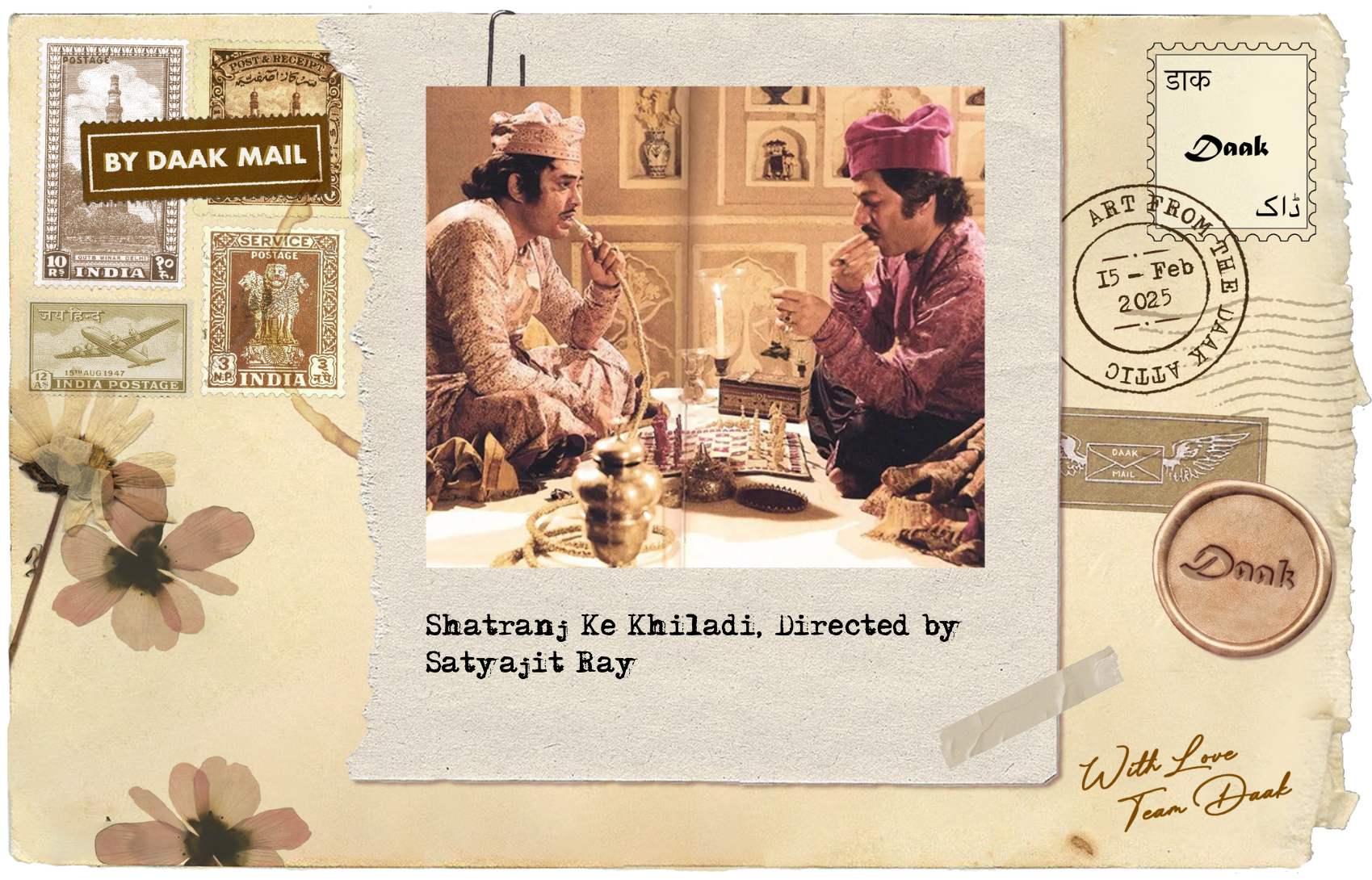
Set in the Lucknow of 1856, Satyajit Ray’s 1977 masterpiece is based on a story by Munshi Premchand. It was his first Urdu feature and one that brought to life the period of annexation of Awadh by British officials. The film captures the penultimate moments of beauty in a society revelling in its culture and art, laced with Ray’s iconic humour.
Premchand’s story features two friends, the eponymous chess players, as protagonists. These two noblemen are wrapped in layers of privilege and comfort and oblivious to the world beyond their ivory and silk chessboard. As the subjects of Nawab Wajid Ali Shah, an aesthete and poet, but an absentee king, they thrive in cultural excesses. Most remarkable in the execution of the film is how Satyajit Ray takes the subtleties in the story and brings them to life — the mention of attar used by the nawab and how its fragrance lingers for days, the dances masterfully choreographed by Birju Maharaj, and the costumes, thoroughly researched and beautifully executed.
In two hours, Shatranj Ke Khiladi touches upon many themes, and not just through the voice of the narrator, but also in its ingenious use of animation, graphics, symbols and paintings, to take the viewer through history. The use of dialogue as a device, interspersed with poetry, brings to life the city of Lucknow as a centre for culture in a rapidly changing world. The scene where the British Resident wants the Awadhi Prime Minister to rush his speech and get to the point, avoiding the use of superfluous speech characteristic of the area, is one that best contrasts these two ways of being in the world.
On one hand, the film is a beautiful ode to a culture of luxury, one where time exists in abundance and leisure is encouraged. On the other hand, it satirises the very same idea — the men don’t pick up arms but get ready to kill over a game of chess. And as much as the two friends don’t care about the crumbling empire around them, a sympathetic, Urdu-speaking white man is shown as the device with which the audience is taught to admire the dysfunctional beauty of the kingdom and culture.
Watch the full movie, The Chess Players.
The film series was part of our collaboration with MUBI to bring you independent and historic cinema.