
An Unlikeable Hero: Bimal Roy’s Movie, Devdas
An enduring story of a broken and flawed man's love and obsession.
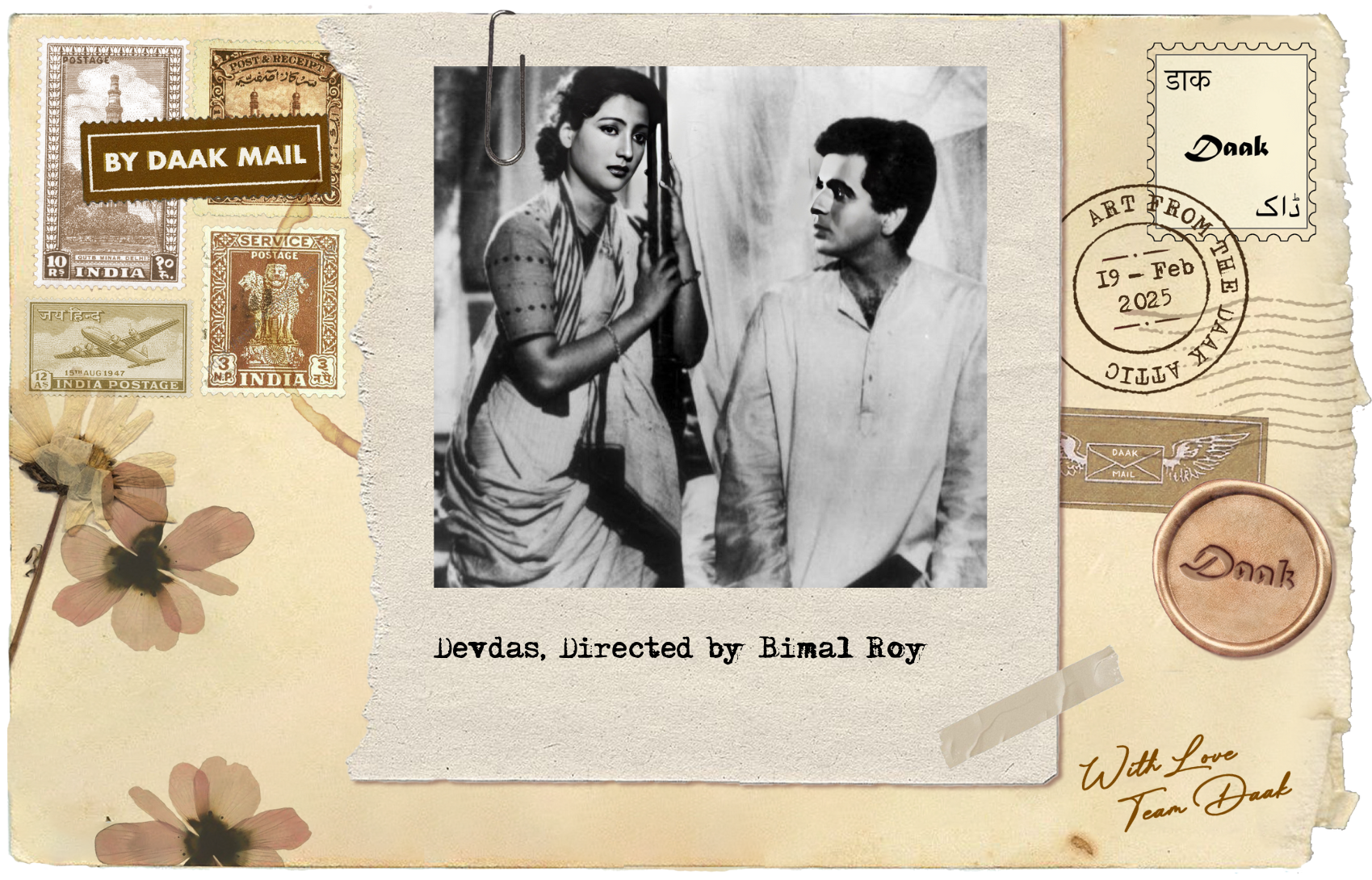
Sharat Chandra Chattopadhyay’s novel, Devdas, is possibly one of the most adapted literary works of the subcontinent, one that has gone beyond the realm of literature and become an adjective adapted in common parlance; “Devdas” is what brooding men pining over their lost lover, are often described as. For the millennial generation in the subcontinent, Shah Rukh Khan brought the character to life but for an older generation, it is the role that Dilip Kumar came to be known best for.
Bimal Roy’s 1955 adaptation stays true to the novel. It tells the tale of an innocent love in a village in Bengal, a love that springs up between a spoilt son of a zamindar and his neighbour. While as children, they frequent each other’s houses, share food and spend their days together, the fondness between them can only go so far. Devdas’ family disapproves of them as a couple because of caste differences. Through a series of misunderstandings coupled with anger, pride and regret, they end up on two separate paths. As Devdas sums it up,
Wo (Paro) shaadi ke raaste pe chal gayi, aur mein barbaadi ke raste.
//
She walked the path of marriage and I, of devastation.
Roy has captured beautiful moments in this part: the innocent affection between two children that then moves into shy, romantic encounters as adults. We see the village school, orchards, minstrel singers singing for alms, courtyards and quotidian lives that conjure up another time. Yet, along with these tender moments, very early on we see what can only be described as a complicated and abusive relationship between the two protagonists.
Upon finding out that his parents won’t allow the match, Paro is confident that Devdas will come through and save her. She abandons worry and takes charge of her feelings only to come face to face with a Devdas paralysed by inaction and ready to flee to Calcutta. The film then proceeds to show his progressive decline into alcoholism, his famous dialogue becoming increasingly true.
Kaun kambakht hai jo bardaasht karne ke liye peeta hai.. main toh peeta hoon ki bas saans le sakun.
//
What wretched person drinks to bear the pain…I drink so I can continue to breathe.
Compared to the bold Paro who unabashedly owns her relationship and then gives it up with the same force of will, Devdas is a meek escapist. This becomes more evident as he meets the dancer, Chandramukhi, who takes a liking to him and falls in a doomed love of her own. Chandramukhi too, displays a strength characteristic of the women in the film: she gives up her profession to take care of this sad and fading man. Devdas however, continues to spiral into alcoholism and depression. In some ways. Dilip Kumar’s nuanced portrayal humanises this rather pitiable character, compelling us to feel the pain of a broken and flawed human.
Adapted from the book by Nabendu Ghosh, the dialogues by Rajinder Singh Bedi are so powerful that they have easily seeped into the colloquial. There is wisdom in the short crisp sentences that has long rung true for audiences, and the film has maintained its appeal across generations.
Watch the full movie, Devdas.
The film series is part of our collaboration with MUBI to bring you independent and historic cinema.