
A Confluence of History and Imagination: Naiyer Masud’s Story, Taoos Chaman Ki Myna
A fantastical tale which brings together loss, talking birds and the landscape of mid nineteenth-century Lucknow.
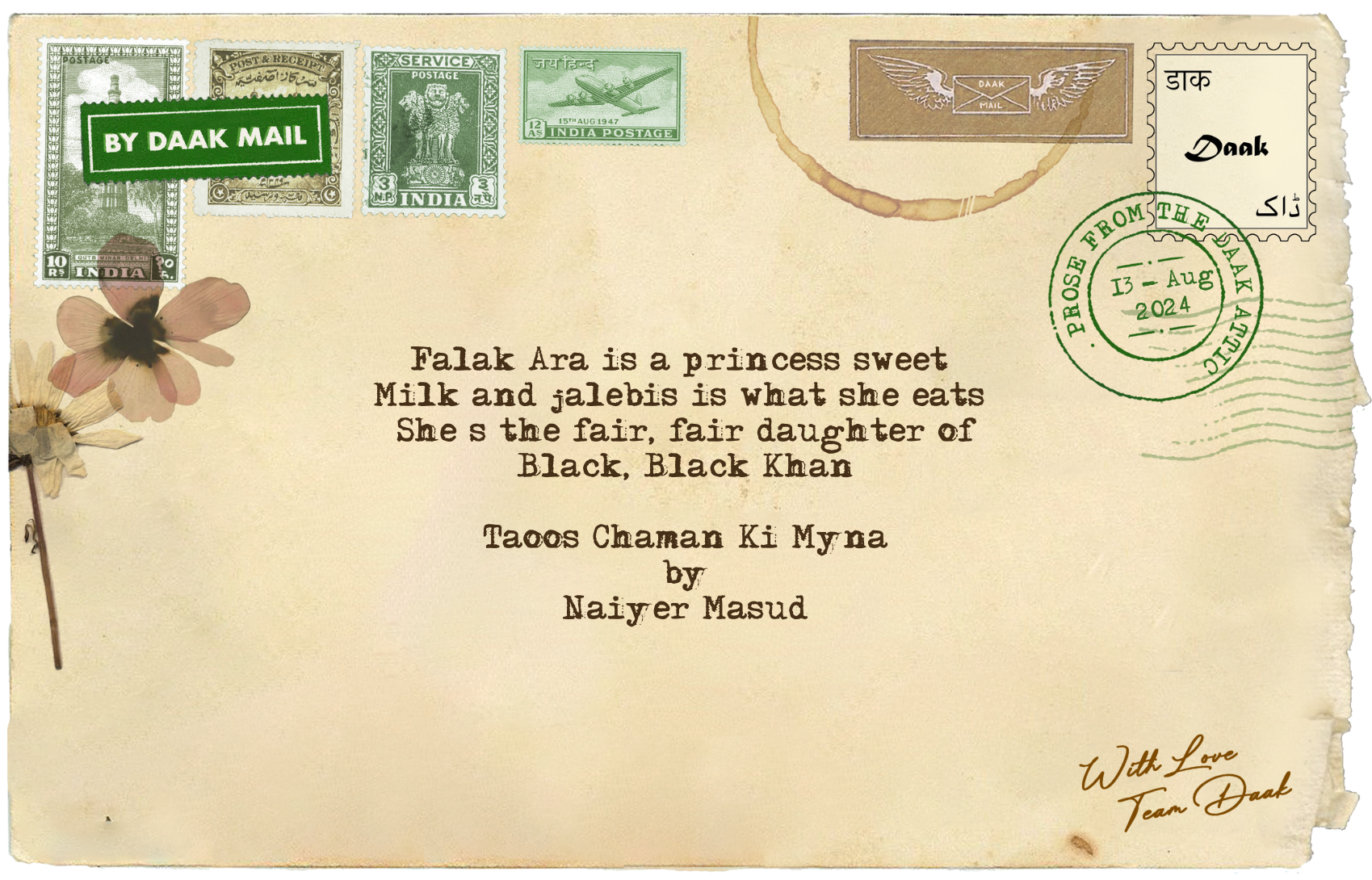
In Naiyer Masud’s classic tale, talking birds, the landscape of mid nineteenth-century Lucknow, and the fantastical world of the royal peacock garden come together. Evocatively titled “Taoos Chaman Ki Myna,” this is easily Masud’s most well-known story.
Published in 1997, the story opens with Kale Khan, a poor, unemployed man inconsolably grieving after his wife’s death. Completely oblivious in his misery to his young daughter, he unexpectedly acquires a job at the Royal Peacock Garden owned by Nawab Wajid Ali Shah, the actual historical figure who was the last Nawab of Awadh. It is at this confluence of imagination and historical truth that the magic begins. As Kale Khan encounters the splendid world of the talking mynas in a grand cage built on royal orders, his heart begins to open towards his daughter and a beautiful relationship develops between the grieving father and daughter.
The poignant moment when he starts calling one of the mynas by his daughter’s name raises no alarm in the reader about what is to come. However, In the ensuing pages, the reader encounters a strangely charming parallel: the daughter, Falak Ara, demands with a childish simplicity, that her father bring her a myna for companionship, while Kale Khan begins to affectionately call his favoured myna, “Falak myna,” after his daughter. As the story advances, a strange twist brings the world of the royal peacock garden and Kale Khan’s small home in Lucknow’s poorer parts into an unlikely intimacy.
The wonder and beauty of the story, though, lies not only in its clever plot, which brings home the glaring paradox of the opulent royal palace and Lucknow’s poorer sections, but in evoking for the modern reader, a world that is so distant it seems almost irretrievable. Here we have none of the elite representations of colonial Lucknow brought forth in Hindi films, none of the stereotypical images of splendour and glamour in the Muslim court. Instead, we have the real flesh of the city — the names and streets and grit, the lives and fears and hopes of an average citizen in Lucknow in the 1850s. And it is in this aspect that Masud’s unique talent becomes evident.
A Persian and Urdu scholar and dedicated researcher for most of his life, Masud turned to fiction later in his life. The immaculate scholar in him becomes evident as he weaves this story of great emotional power and simplicity. This is a rare feat in literature, to write a story equally for children and adults in a historically rooted and contextual setting. It is a delight not only for the heart, in its depiction of a father-daughter relationship against the odds, but also for anyone interested in the history of places, allowing the reader to feel the texture of nineteenth century Lucknow in this great classic of Urdu literature.
Read the original book in Urdu.